
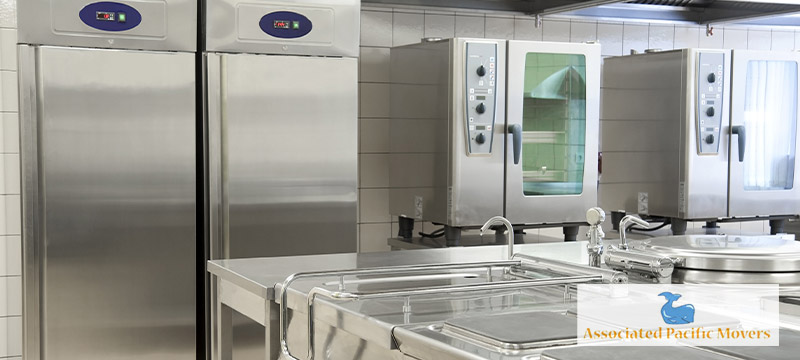
Relocating a restaurant means moving far more than tables and chairs. Professional restaurant equipment movers are equipped to handle commercial ovens, refrigerators, prep equipment, cooking systems, and other heavy kitchen machinery that cannot be safely handled with ordinary moving methods.
As a restaurateur, you know that the restaurant business is one of the most turbulent and challenging industries there is.
Much of your success is based on location, visibility, and other similar considerations, many of which can be difficult or impossible to control.
These basic facts about the industry and a wavering economy can make changing locations an important survival strategy for your business.
Moving may also be a necessity when you are very successful and need to expand, which is a nice problem to have.
Of course, the tools of your trade are huge appliances that cannot be moved by a couple of guys and a truck.
You need specialized services and capabilities to move your equipment. The experienced crews at Associated Pacific Movers have the equipment and experience required to plan moves involving oversized, heavy, and difficult-to-handle commercial assets.
Our team of restaurant equipment movers is well trained, highly experienced, and properly equipped to handle even the biggest list of kitchenware.
Types of Heavy Restaurant Equipment
22 Examples of Heavy Restaurant Equipment That We Move
- Ovens
- Ranges
- Ventilation equipment
- Food processors
- Mixers & slicers
- Food prep counters
- Cutting boards
- Freezers & refrigerators
- Safety equipment
- Storage racks and shelving
- Cooking equipment
- Serving ware
- Containers
- Sinks
- Display systems
- Point of sale systems
- Steam tables
- Washing equipment
- Sharpening stones
- Microwaves
- Ice makers
- Gas & electric grills
How Do Restaurant Equipment Movers Handle Commercial Kitchens?
It takes a lot of careful planning to move a major appliance. If you have ever moved house or helped a friend move, you understand this.
Of course, moving large commercial-grade kitchen equipment is on another level altogether. Specialized lifting equipment, transport vehicles, trained crews, and careful load planning may all be required. Businesses moving large appliances, machinery, or other commercial assets can also review our commercial equipment transport services for projects involving complex loading and transportation requirements.
In some instances, it may be necessary to temporarily remove part of a wall. We can work with contractors to deconstruct and reconstruct obstructing structures.
It is even possible to install wider warehouse doors to eliminate the obstruction permanently.
We start by developing a restaurant moving plan specially for your needs. Every restaurant is different, with different equipment and different arrangement needs.
You have a unique set of equipment and a specific way of doing things. That means you need certain items to be moved in a certain order and arranged in a certain way.
This will all go into your restaurant moving plan.
In addition to this, we take your deadlines, such as your opening day, the lease plan for the building you are moving out of, and more into consideration.
Plus, we know how valuable your kitchen equipment is and how much it means to you. That is why we give everything the white-glove treatment from point A to point Z.
How to Move a Commercial Pizza Oven
A massive pizza oven can present one of the toughest challenges in a restaurant relocation because its size, weight, shape, utilities, and location inside the building all affect how it can be removed.
Even many smaller commercial pizza ovens are too heavy to be moved safely by hand. Depending on the equipment and access conditions, forklifts, cranes, rigging systems, dollies, or other specialized lifting equipment may be needed before the oven can be loaded for transport.
The best lifting tool for the job is determined by the layout of the building, the available working space, equipment dimensions, weight, clearance, and the path between the starting location of the oven and the transport vehicle.
Particularly heavy or oversized commercial equipment may require the same specialized planning used for heavy equipment hauling, including trailer selection, load distribution, lifting coordination, and securement.
The right securement gear is also required based on the size, weight, and proportions of the equipment. The Federal Motor Carrier Safety Administration cargo securement rules establish requirements intended to prevent cargo from shifting, falling, or otherwise becoming unstable during commercial transportation.
Everything we do is built around ensuring that the appliance gets where it needs to go in a timely fashion and in the same condition it left in.
How Do You Move Commercial Restaurant Equipment?
The way we load the truck is another matter for an expert team. What goes in and in what order is a key consideration.
Large sets of equipment need to be properly dispersed across the truck bed for stability, and everything needs to be padded, packed, and secured appropriately for the move.
Commercial kitchens can include equipment with dramatically different weights and dimensions. A walk-in refrigeration component, deck oven, prep table, mixer, ice machine, and stainless-steel shelving system cannot automatically be handled or secured in the same way. Equipment dimensions, weight distribution, lifting points, fragility, and available access all influence the moving plan.
What Should Be Done Before Restaurant Equipment Movers Arrive?
Proper preparation can help reduce delays and make the relocation process more efficient. Before moving day, restaurant owners and facility managers should identify which equipment is moving, confirm equipment measurements, and determine whether utilities or fixed connections require attention from qualified tradespeople.
- Create an inventory of the equipment being relocated.
- Record dimensions and approximate weights when available.
- Identify narrow doorways, hallways, stairs, loading docks, and other access restrictions.
- Confirm which appliances require electrical, gas, water, drainage, or ventilation disconnection.
- Remove food, liquids, loose accessories, trays, racks, and detachable components where appropriate.
- Confirm the destination is ready to receive the equipment.
- Plan equipment arrival around contractors, installers, inspectors, and reopening schedules.
Planning these details before loading begins can prevent a heavy appliance from reaching the destination before the building is actually ready to accept it.
Planning a Commercial Kitchen Equipment Move
Restaurant relocations often involve more coordination than a typical commercial move because so many pieces of equipment interact with the building itself. Cooking appliances may connect to electrical, gas, plumbing, ventilation, fire suppression, or drainage systems. Refrigeration equipment may have specific handling requirements, and unusually large equipment may have very limited exit paths.
That is why the physical move should be coordinated with any qualified electricians, plumbers, HVAC professionals, equipment technicians, or other contractors needed to disconnect or reinstall specialized systems.
A detailed plan also helps determine whether equipment can move through existing openings or whether additional access will be required. Measurements should account for more than the appliance itself. Movers may also need working clearance for lifting devices, dollies, rigging, padding, turning radius, ramps, and loading equipment.
Why Restaurant Equipment Movers Plan the Loading Order
The loading order affects both transportation and unloading. Equipment required first at the destination may need to be positioned so crews can access it without unnecessarily handling other pieces. At the same time, vehicle stability and cargo securement requirements determine where heavy items can safely be positioned.
A successful plan balances these factors so the equipment can be transported securely and unloaded in a practical sequence.
Frequently Asked Questions About Restaurant Equipment Moving
What equipment can restaurant equipment movers relocate?
Restaurant equipment movers can handle many types of commercial kitchen equipment, including ovens, ranges, refrigerators, freezers, mixers, food preparation equipment, steam tables, ice machines, stainless-steel fixtures, shelving, and other large appliances or machinery.
Can commercial pizza ovens be moved?
Yes. Commercial pizza ovens can often be relocated, although the appropriate method depends on the oven’s weight, dimensions, construction, building access, and available lifting equipment. Some moves may require forklifts, cranes, rigging equipment, or temporary modifications to an access opening.
Do restaurant appliances need to be disconnected before moving?
Equipment connected to gas, electrical, plumbing, ventilation, refrigeration, or fire suppression systems may require qualified tradespeople or technicians to disconnect and reconnect those systems. These requirements should be identified during move planning.
How is heavy restaurant equipment secured during transportation?
The securement method depends on the equipment’s size, weight, shape, fragility, and transport method. Commercial loads may require appropriate tiedowns, blocking, bracing, padding, or other securement methods to prevent shifting or damage during transportation.
How far in advance should a restaurant equipment move be planned?
Planning should begin as early as practical, especially when the move involves large appliances, restricted access, utility disconnections, specialized lifting equipment, multiple contractors, or a firm reopening deadline.
Get Help Moving Heavy Restaurant Equipment
Your job is to fire up those burners on the other end of the move. Our job is to carefully plan the lifting, loading, transportation, and unloading required to get your commercial equipment there.
When you are preparing to relocate a restaurant, commercial kitchen, or individual piece of heavy food-service equipment, contact Associated Pacific Movers for a project estimate and discuss the equipment, access conditions, timing, and transportation requirements involved.