

A building move route survey is the process of physically checking a proposed transport path, measuring vertical and horizontal clearances, grade changes, bridge capacity, and permitting requirements, before a structure is ever loaded for transport. For property owners, developers, and historic preservation projects, the first question is usually simple: can this building physically reach its new site?
Answering that question takes more than typing two addresses into a GPS app. A proposed route has to be reviewed in person so the moving crew can spot conflicts before the structure leaves the ground.
What Is a Building Move Route Survey?
A building move route survey is a detailed, on-the-ground review of every road, intersection, bridge, and utility line a structure will pass on its way to a new site. It typically covers:
- Vertical clearance measurements at bridges, wires, and signals
- Road and bridge width evaluations
- Ground clearance and grade-change checks
- Bridge and roadway weight restrictions
- Turning and maneuvering requirements at intersections
- Railroad crossing evaluations
- Utility and traffic control considerations
- State and local permitting requirements
A route survey does not guarantee a building can be relocated on its own. It provides the measurements and observations that movers, engineers, permitting agencies, and utility companies use to decide whether a route is workable or whether it needs modifications.
Why a Physical Route Survey Matters More Than a Map
Relocating an entire structure involves far more than placing it on transport equipment and driving to the new address. A building’s dimensions, weight, trailer configuration, axle spacing, ground clearance, and turning requirements all determine which roads can actually accommodate the move. Utility lines, traffic signals, bridges, railroad crossings, trees, active construction zones, and roadside furniture can all create conflicts that a digital map will never flag.
How a Building Move Route Survey Differs From GPS Mapping
Federal Highway Administration guidance for pilot and escort vehicle operators stresses thorough pre-trip route review, and for good reason. Digital maps and state databases are useful starting points, but they rarely reflect temporary construction, a recently lowered wire, or a newly posted weight restriction. Only a physical drive of the route, measuring tape and height pole in hand, catches those changes before they become a problem on moving day.
Evaluating Vertical Clearance
Overhead clearance is one of the first things a surveyor checks. Common vertical obstacles include:
- Bridges and overpasses
- Utility and communication lines
- Traffic signals
- Road signs
- Overhanging tree branches
- Temporary construction equipment
For tall loads, a lead escort vehicle often runs a height pole mounted a few inches above the tallest point of the structure so the operator can spot an obstruction before the load reaches it. If a conflict shows up, the crew has to verify the exact clearance and decide whether another route is needed or whether a utility company needs to temporarily raise a line.
Measuring Horizontal Clearance and Turning Requirements
Height is only half the equation. A building can also be far wider than a standard traffic lane, so the survey looks at narrow points such as:
- Bridges and guardrails
- Concrete barriers and utility poles
- Traffic signs and mailboxes
- Narrow shoulders and construction zones
Turning movements deserve extra attention. A long or wide structural load can require far more room than an ordinary vehicle when it enters an intersection or negotiates a curve, and trailer design, axle configuration, and overhang all factor into the required turning path. When a turn cannot be completed safely, the crew either selects a different route or coordinates temporary measures with the agency responsible for that stretch of road.
Ground Clearance, Grade Changes, and Railroad Crossings
Lowering the overall height of a load, often by raising the structure onto a low-boy or deep-well trailer before transport, can introduce a different problem: limited ground clearance. Lower trailers are more vulnerable to abrupt grade changes, including:
- Raised railroad crossings
- Steep driveway entrances
- Sharp crests and deep dips
- Sudden pavement transitions
- Uneven surfaces in construction zones
Railroad crossings deserve particular caution. Federal guidance recommends accounting for approach angle, departure angle, and trailer ground clearance at every crossing along the route. The stakes are real: a 150-car freight train moving at 50 miles per hour needs roughly 8,000 feet, about a mile and a half, to come to a stop. That is exactly why a transport vehicle should never enter a crossing unless the driver is confident the entire load can clear the tracks without stopping.
Checking Weight Limits and Bridge Restrictions
A building and its transport equipment can add up to a substantial gross weight, so route planning has to account for axle weights, axle spacing, posted bridge restrictions, and roadway weight limits. Adding axles helps distribute weight across a larger area, but that alone does not guarantee a bridge can handle the load. State transportation agencies, and sometimes bridge engineers, evaluate whether a specific structure can accommodate an unusually heavy configuration, and requirements differ from one jurisdiction to the next depending on the route, axle loading, and spacing.
The Role of Pilot and Escort Vehicle Operators
Pilot and escort vehicle operators, often called P/EVOs, play a central role in many structural moves. Their responsibilities typically include:
- Identifying upcoming hazards along the route
- Operating a height pole when required
- Communicating with the load driver
- Monitoring turns and roadside clearances
- Coordinating with other escort vehicles
- Following the specific requirements of the permit
Federal guidance recommends that, whenever possible, the same lead escort operator who will accompany the load also conducts the original route survey. An operator who has personally driven the route already knows where the tight turns, low wires, and railroad crossings are, which makes communication with the transport driver much faster on moving day.
Permitting Rules for Idaho and Oregon Building Moves
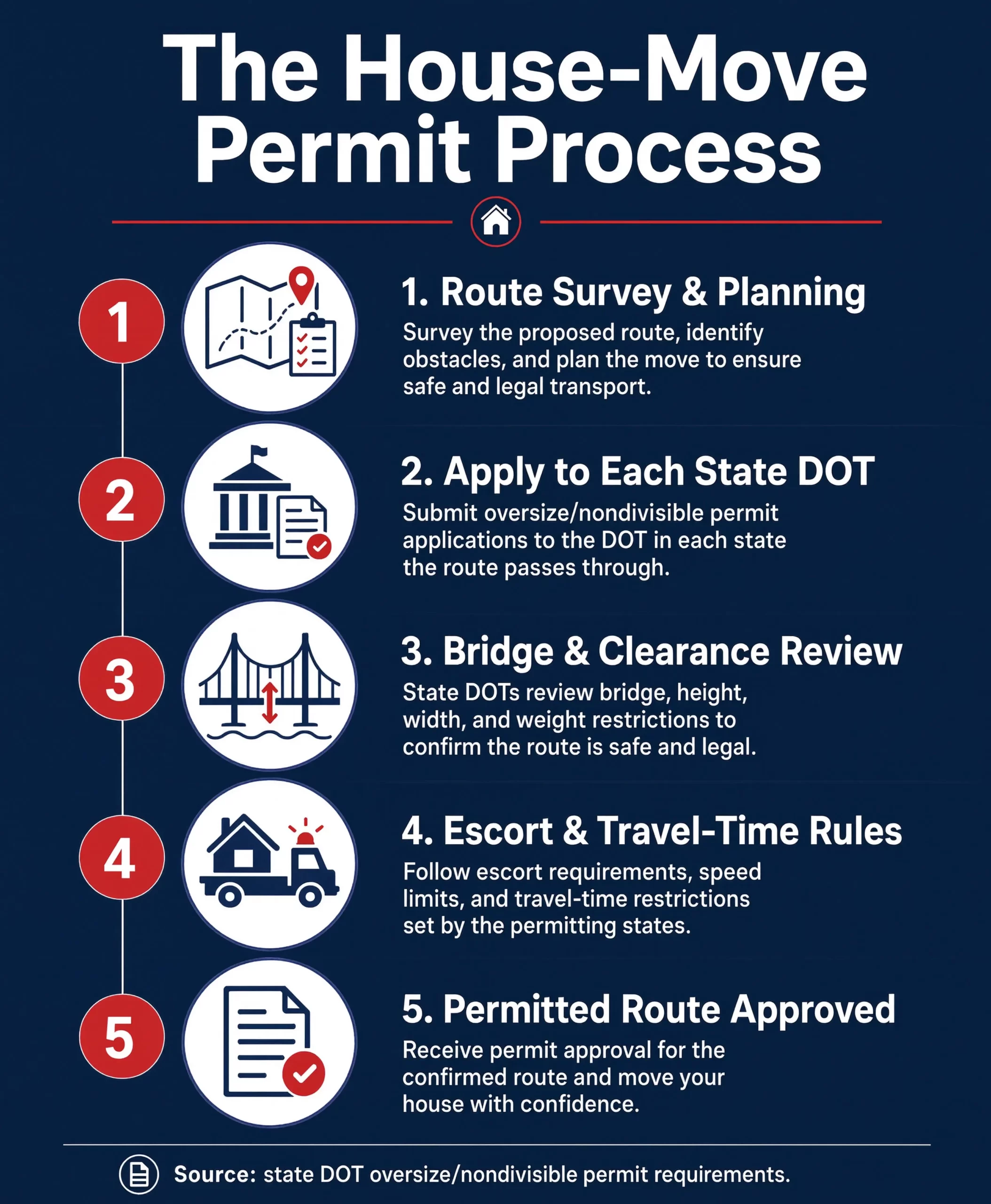
Oversize-load permitting is not a single nationwide process. Depending on the route, a move may involve state transportation agencies, county governments, municipal governments, highway districts, utility companies, railroad companies, and local law enforcement or traffic control personnel. A state permit does not automatically cover every locally controlled road, either, so carriers need to confirm requirements for the specific route being used.
Idaho Requirements
Idaho Transportation Department rules tie permit requirements for relocating a used building to factors such as load dimensions, roadway width and alignment, opportunities for other traffic to pass, vertical and horizontal clearance, and traffic volume. Extremely large loads may also require district review, a traffic control plan, or restricted travel hours. For certain two-lane highway moves, Idaho requires a traffic control plan once a load exceeds specific thresholds, generally loads wider than 18 feet, taller than 16 feet, or longer than 150 feet.
Oregon Requirements
Oregon also maintains detailed over-dimension rules, and vehicles exceeding legal dimensions or weights generally need over-dimension authorization, though house moves on state highways follow a separate house-move permitting process. Oregon places responsibility on the carrier to confirm sufficient vertical and horizontal clearance for an overheight movement, and depending on the load, additional requirements can include pilot vehicles, height poles, certified flaggers, route restrictions, bridge review, and utility coordination.
Regional Challenges Around Boise and the Treasure Valley
Structural moving around the Boise area and the Treasure Valley involves very different conditions depending on the route. Urban stretches often bring closely spaced traffic signals, overhead utility lines, busy intersections, restricted travel windows, and active construction. Rural and mountainous routes bring their own challenges, including winding two-lane highways, limited shoulders, steep grades, railroad crossings, weight-restricted structures, and few practical detour options. An experienced moving crew evaluates the entire path rather than simply picking the shortest line between two addresses, and coordinating that review is a core part of any structural building relocation project.
How a Route Survey Affects Your Budget and Timeline
The condition of the route has a direct effect on cost. A short, straight route with generous clearance costs far less to permit and escort than one that requires utility coordination, a traffic control plan, or a detour around a weight-restricted bridge. Structural relocation projects generally range from around $18,000 to well over $100,000 depending on distance, permitting complexity, and the size of the structure, while a typical house lifting project runs $30,000 to $70,000 and a smaller pier-and-beam lift can come in closer to $10,000 to $25,000.

Getting a route survey done early gives an accurate picture of permitting timelines and any utility coordination that will add to the schedule, which makes it much easier to build a realistic budget before a moving date is set.
Frequently Asked Questions
How long is a building move route survey good for?
There is no single nationwide expiration period. Permit duration and route survey requirements vary by jurisdiction and permit type, and even a valid permit can be affected by road construction, utility work, weather, or newly posted restrictions. It is worth confirming that route information is still current before the move date.
What happens if a building hits an overhead line or bridge?
The consequences depend on the jurisdiction, the specific permit conditions, and applicable insurance and liability rules. Damage to bridges, traffic signals, or utility infrastructure can create significant liability and delay a project, and some states place responsibility for that kind of damage directly on the carrier. Accurate clearance verification during the survey is what prevents this from happening in the first place.
Do cities and counties require separate permits from the state?
Sometimes. A state oversize permit does not automatically cover every locally controlled road. Some states coordinate local permits through a centralized system, while others require carriers to get authorization directly from the city, county, or road district involved, so this has to be checked for the specific route.
Can GPS or Google Maps replace a physical route survey?
No. Digital maps are useful for initial planning, but they are not reliable for every overhead wire, tree branch, temporary construction condition, or grade change. A physical review provides information specific to the actual load and the roadway conditions on the day of the survey.
Who is responsible for conducting the route survey?
The carrier is ultimately responsible for meeting permit and route survey requirements. In practice, route surveys are often conducted by the pilot and escort vehicle operators who will accompany the load, and having the lead escort personally drive and measure the route ahead of time improves safety and communication on moving day.
Plan Your Building Move With Associated Pacific Movers
Associated Pacific Movers has handled specialized structural moves since 1973, giving our crew more than five decades of hands-on experience with building relocation, house lifting, and heavy-haul logistics. We operate out of Boise, ID, and take on projects throughout Idaho and the surrounding region.
Planning a structural move starts with understanding the building itself, the transport configuration it needs, and the route it will travel. Working through clearance restrictions, roadway conditions, and permitting requirements before moving day is what keeps a relocation project on schedule and on budget.
To talk through a structural relocation project, call 208-376-8660 or request a moving quote from our team. For additional background on how federal guidelines shape route planning for oversize loads, the FHWA route planning training manual is a useful public resource.