
Structure lifting is one of the most technically demanding services in the construction and relocation industry. When a building needs to be raised to install a new foundation, improve flood resilience, or prepare for transport, the margin for error is extremely small. Structure lifting specialists bring the engineering knowledge, precision equipment, and methodical planning required to protect every component of a building during the elevation process. From pre-lift assessments to synchronized hydraulic systems and real-time monitoring, every step is designed to reduce stress on the foundation and keep the structure stable. If you need a building raised, lowered, or repositioned anywhere in Idaho, Associated Pacific Movers has provided expert lifting and relocation services for over 40 years, and you can reach the team directly to discuss your project.
What Structure Lifting Specialists Do to Protect Your Foundation
Structure lifting specialists are responsible for safely elevating buildings while maintaining structural stability at every stage of the process. Their work begins long before any equipment is placed beneath a structure. Specialists evaluate the building’s size, age, materials, and existing foundation conditions to determine the safest lifting strategy. This includes identifying load paths, weight distribution, and potential weak points that could be stressed during elevation.
The goal is not just to lift a structure, but to do so in a controlled, incremental manner that protects both the building and the foundation. By relying on engineering calculations rather than guesswork, specialists minimize the risk of cracking, shifting, or long-term structural damage. This level of precision is what separates a professional lift from an improvised approach that risks the entire structure.
Core responsibilities typically include:
- Conducting structural assessments and engineering reviews
- Designing a customized lifting plan based on building specifications
- Selecting and calibrating lifting equipment for uniform load transfer
- Monitoring movement in real time to prevent uneven stress
- Coordinating foundation repair, replacement, or relocation logistics
Evaluating the Structure Before Any Equipment Is Placed
Before a single jack is set, specialists conduct a detailed review of the building and its surroundings. This means examining the condition of load-bearing walls, floor joists, sill plates, and the existing foundation. Soil stability beneath and around the structure is assessed to ensure temporary supports will hold their position throughout the entire lift. Any previous settling, cracking, or moisture damage is documented and addressed before work begins.
This initial review also determines where lifting points should be placed. Load distribution across multiple contact points is critical to a successful lift. Placing equipment incorrectly, even by a small margin, can create stress concentrations that crack the foundation or warp the framing. Careful pre-lift evaluation eliminates most of the guesswork that leads to preventable damage during building raises.
How Structure Lifting Specialists Use Hydraulic Systems and Precision Equipment
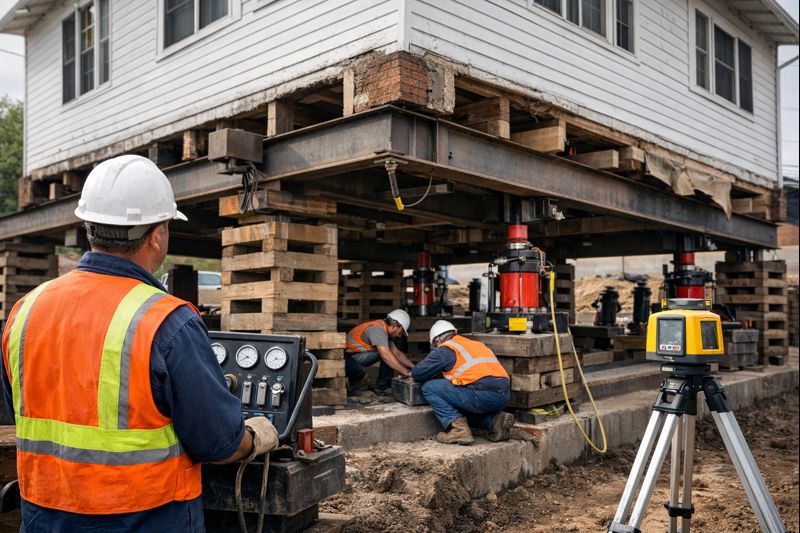
Modern building lifts rely on hydraulic jack systems that are far more sophisticated than portable jacks used in light construction work. Unified hydraulic systems allow multiple jacks to rise simultaneously at the same rate, distributing the load evenly across the entire base of the structure. This synchronized movement is what prevents one side from lifting faster than another, which is one of the most common causes of foundation cracking and wall separation.
In addition to hydraulic jacks, specialists use steel beams and cribbing to distribute weight evenly between jack points and the ground. Load monitoring sensors track pressure in real time, alerting the team if any point is taking more force than intended. Laser leveling equipment maintains alignment throughout the lift, ensuring the building rises true and does not tilt or rack during elevation.
Common tools and systems used in professional lifts include:
- Unified hydraulic jack systems for synchronized lifting
- Steel beams and cribbing to distribute weight evenly
- Load monitoring sensors to track pressure and movement
- Laser leveling equipment to maintain alignment
- Custom-engineered supports for unique or irregular structures
Load Monitoring, Laser Leveling, and Real-Time Adjustments
One of the most important aspects of a professional lift is the ability to identify and correct problems before they become serious. Load monitoring equipment gives the crew instant feedback on how the structure is responding. If one jack point registers unexpected pressure, the team can pause, reassess, and redistribute load before any damage occurs.
Laser leveling takes the subjectivity out of alignment checks. Rather than relying on visual estimation, specialists use precise instrumentation to verify that the structure maintains a level plane throughout the elevation. Small deviations that might go unnoticed by the naked eye can indicate uneven lifting conditions that require immediate adjustment. This combination of real-time monitoring and precision measurement is what allows professionals to safely raise structures that weigh tens of thousands of pounds.
Structure Relocation Services for Raising and Securing Buildings
When the goal is full relocation rather than lifting in place, the complexity increases significantly. Structure relocation services involve raising a building, securing it to a transport system, moving it to a new site, and lowering it onto a prepared foundation. Each of these phases carries its own set of risks, and the transition between phases requires careful coordination. For a closer look at how professionals manage the full process from start to finish, the building raising and house lifting services offered by Associated Pacific Movers cover both in-place lifts and full relocations.
Relocation services often include:
- Temporary support systems to stabilize the structure during lifting
- Gradual elevation in small increments to reduce stress
- Reinforcement of structural components when necessary
- Continuous alignment checks to keep the building level
- Secure placement onto new foundations or transport systems
By raising structures slowly and uniformly, professionals reduce the likelihood of foundation cracking or structural distortion. The process allows engineers to pause, inspect, and adjust as needed, ensuring the building remains stable throughout the project. For projects that involve moving a building to an entirely new location, the breakdown of how structural relocation contractors move entire homes provides additional context on what the full process looks like from start to finish.
Temporary Support Systems and Incremental Elevation
Temporary support systems are one of the most critical elements of a safe lift. These systems hold the structure in place at various stages of the elevation process, allowing the crew to reposition equipment, inspect progress, or make corrections without the building resting on active jacks for extended periods. Cribbing towers, steel frames, and adjustable shoring are commonly used depending on the building type and height requirements.
Incremental lifting means the building rises in small stages rather than in one continuous movement. After each increment, the crew pauses to verify level, check load readings, and inspect the structure for any signs of stress. This methodical approach takes more time than a single continuous lift, but it dramatically reduces the risk of sudden failure or unexpected movement that could damage the foundation or the structure above it.
Safety Inspections That Happen Before the Lift Begins
Safety inspections are a required step in preventing foundation damage. Before any lifting begins, specialists conduct thorough inspections to identify existing weaknesses or conditions that could be exacerbated during elevation. This includes examining the foundation, framing, and connections between structural elements. In Idaho, projects involving structural alterations may also require coordination with the Idaho Division of Building Safety to ensure permits and inspections are properly handled before work begins.
What Structure Lifting Specialists Look for During Pre-Lift Assessments
Pre-lift assessments focus on identifying conditions that could compromise the lift or cause unexpected behavior during elevation. Inspections typically focus on:
- Existing cracks or settlement in the foundation
- Condition of load-bearing walls and beams
- Soil stability beneath and around the foundation
- Presence of moisture damage or rot in structural framing
- Compatibility of the structure with the planned lifting equipment
- Location of utilities, plumbing, and mechanical connections that may need to be temporarily disconnected
By addressing these issues in advance, professionals can reinforce or repair vulnerable areas before lifting begins. This proactive approach significantly reduces the likelihood of unexpected failures and ensures the structure responds predictably to lifting forces. Understanding what to expect from these inspections is also covered in the guide to foundation repair and house lifting services in Idaho.
How Structure Lifting Specialists Respond to Common Lifting Challenges
Even with careful planning, structure lifting can present challenges that require expert intervention. Common issues include uneven settling, shifting loads, or unexpected resistance from older materials. Professionals are trained to recognize these problems early and adjust their approach to prevent damage.
Structure Lifting Specialists and the Problem of Differential Lifting
Differential lifting occurs when one side or corner of a building rises faster or higher than the others. This is one of the most dangerous conditions during a lift because it places unequal stress on the foundation and framing, which can lead to cracking, separation, or collapse of weakened sections. Specialists prevent this by using synchronized hydraulic systems and monitoring elevation at multiple points simultaneously. When differential movement is detected, the lift is paused and load points are adjusted before proceeding.
Typical challenges that arise during the lifting process include:
- Differential lifting where one side rises faster than another
- Hidden structural weaknesses revealed during elevation
- Soil movement affecting temporary supports
- Weather conditions impacting stability
- Aging materials that respond unpredictably to stress
When these issues arise, specialists pause the lifting process and make necessary adjustments. This may involve redistributing load points, reinforcing supports, or modifying the lifting sequence. The ability to respond quickly and effectively is essential to preventing foundation cracking or structural compromise.
Signs Your Property May Require a Professional Building Lift
Not every property owner recognizes when a building lift is the right solution. Some situations are obvious, such as a home in a flood zone that needs to be raised to meet FEMA elevation requirements. Others are less clear, such as gradual foundation settlement that has gone unaddressed for years. Understanding the circumstances that lead property owners to call structure lifting specialists helps clarify when professional intervention is the right call.
Flood Risk, Foundation Failure, and Relocation Planning
Flood risk is one of the most common reasons property owners choose to raise a building. Elevating a structure above the base flood elevation reduces insurance costs, protects the building from water damage, and brings the property into compliance with local floodplain regulations. Foundation failure is another frequent trigger. When a foundation has settled unevenly, cracked significantly, or deteriorated beyond repair, lifting the structure to replace or reinforce the foundation is often more cost-effective than demolition and reconstruction.
Common Scenarios That Warrant a Foundation Lift
- Visible cracks in foundation walls that have worsened over time
- Floors that have become noticeably uneven or sloped
- Doors and windows that stick or no longer close properly
- A structure in a designated flood zone requiring FEMA compliance
- A historic or valuable building being moved to a new site for preservation
- Foundation repair that requires full access beneath the structure
For guidance on when a professional lift makes sense and what the scheduling process looks like, the article on when to hire foundation raising contractors in Idaho provides a helpful breakdown. For projects that go beyond lifting to include full relocation, home and building moving services in Boise cover the broader scope of what that kind of project involves from initial lift to final placement.
The Engineering Expertise Behind Every Successful Foundation Lift
Experience is one of the most valuable assets structure lifting specialists bring to a project. Each building presents unique challenges, and seasoned professionals draw on past projects to anticipate potential risks. Engineering expertise ensures that lifting plans are grounded in proven principles rather than assumptions. Experienced teams understand how different materials behave under stress, how soil conditions affect stability, and how to adapt equipment configurations to suit specific structures.
The table below outlines how key elements of the lifting process contribute directly to foundation protection:
| Lifting Element | Why It Protects the Foundation | What Happens Without It |
|---|---|---|
| Synchronized hydraulic jacks | Keeps all lifting points rising at the same rate | Uneven lift causes cracking and wall separation |
| Pre-lift structural inspection | Identifies weaknesses before they cause failures | Hidden damage worsens under lifting stress |
| Load monitoring sensors | Tracks pressure in real time at every jack point | Overloaded points go undetected until damage occurs |
| Incremental elevation stages | Allows inspection and correction between stages | Continuous lifts bypass opportunities to catch problems early |
| Laser leveling equipment | Verifies true alignment throughout the lift | Tilt and racking go unnoticed without precision measurement |
| Temporary cribbing and shoring | Supports the structure during equipment repositioning | Unsupported structure risks sudden unexpected settling |
Why Choosing an Experienced Team Matters for Foundation Safety
Attempting to lift or raise a structure without professional guidance can lead to serious consequences. Improper equipment, uneven lifting, or inadequate planning can result in cracked foundations, warped framing, or even total structural failure. Professional structure lifting specialists mitigate these risks by applying engineering precision, advanced tools, and systematic oversight at every stage of the project.
For property owners, this means confidence knowing that their investment is protected. A professionally lifted structure is more likely to retain its value, meet safety standards, and perform as intended for decades to come. Projects that also involve permit requirements benefit from understanding what permits are required for building relocation in Idaho before work begins, since permit coordination is part of the overall project timeline and can affect scheduling significantly.
Frequently Asked Questions About Structure Lifting Specialists
How do structure lifting specialists prevent foundation cracking?
Specialists prevent cracking by distributing the lift evenly across multiple hydraulic jack points, using synchronized systems that raise all points at the same rate, and monitoring load pressure in real time. Incremental lifting with inspection pauses between stages also reduces the stress placed on the foundation at any single moment during the process.
How long does a professional building lift take?
Duration depends on the size of the building, the height of the lift, the condition of the existing foundation, and whether the project involves in-place lifting or full relocation. Smaller residential lifts may be completed in one to two days, while larger or more complex projects can take several days to complete safely.
Do I need a permit to have my structure lifted in Idaho?
In most cases, yes. Structural modifications including building raises typically require permits from local building departments, and some projects may also require coordination with state agencies. Your lifting contractor should help identify the specific permit requirements as part of the initial planning process.
Can an older home be safely lifted without damaging it?
Yes, but older homes require additional care during the pre-lift inspection phase. Aging materials, outdated construction methods, and years of settlement mean that structural weaknesses are more likely to be present. Experienced specialists identify and reinforce these areas before the lift begins to prevent problems during elevation.
What should I do to prepare my property before a structure lifting project?
Property owners should disconnect or have professionals disconnect utilities that could be damaged during the lift, remove fragile items from the interior, and clear access around the base of the building for equipment placement. Your contractor will provide a specific preparation checklist based on the scope of your project and the height of the planned lift.
What is the difference between building lifting and building relocation?
Building lifting raises a structure in place, typically to replace or repair the foundation, add crawl space height, or meet flood elevation requirements. Building relocation moves the structure to an entirely new site. Both processes start with the same lifting phase, but relocation adds transport, route planning, and placement on a new foundation as additional steps in the project.
Talk with Idaho’s Structure Lifting Experts
When a building needs to be raised, the quality of the lifting team determines whether the foundation survives the process intact. Associated Pacific Movers, Inc. has spent over 40 years providing expert building raising and house lifting services to residential and commercial clients across Idaho. From hydraulic lift systems to full structural relocation, the team brings the equipment, experience, and engineering knowledge to protect your structure from the first lift to the final placement. Contact Associated Pacific Movers to discuss your project and get started with a team that takes foundation protection seriously on every job.