

Moving a building means every pipe, wire, and cable tied to the ground has to be cut loose before the structure leaves its foundation, and utility disconnection for house moving is the step that decides whether lift day happens on schedule. Associated Pacific Movers has relocated houses, mobile homes, and detached buildings since 1973, and the delays we see most often start with a utility company that was never called.
Who Handles Utility Disconnection for House Moving?
The property owner schedules utility disconnection for house moving by calling each provider and hiring licensed trades to cap the lines, while the moving company handles the lift, route, permits, and overhead line clearance. Both sides must finish before the house leaves the foundation.
Utility accounts, meters, and service connections belong to the account holder and the provider, so shutoff requests have to come from the owner. The mover controls everything that happens to the structure itself. The table below shows how the work divides on a typical move.
| Task | Who arranges it | Who performs it |
|---|---|---|
| Close accounts and request shutoff dates | Property owner | Utility provider |
| Cap gas, water, sewer, and electrical lines at the structure | Property owner | Licensed plumber, gas fitter, and electrician |
| Pump and disconnect the septic tank | Property owner | Septic contractor |
| Remove propane tanks, solar panels, and battery storage | Property owner | Propane supplier or licensed installer |
| Call 811 before any trenching or foundation digging | Whoever is digging | Digline notifies the utility owners |
| Overhead line lifts or temporary de-energizing along the route | Moving company, with the owner | Utility crew |
| Lift, route survey, oversize permits, and transport | Moving company | Associated Pacific Movers crew |
Walking through this list early with a whole-house relocation crew keeps the owner’s calls and the mover’s schedule in step. Your estimator can tell you which lines your specific property has and which ones are easy to overlook.
Why Every Utility Line Must Be Cut Before the Lift
A house lifted on hydraulic jacks moves as one rigid unit, and any pipe or conduit still anchored in the ground fights that movement. A steel gas line, copper water supply, or cast-iron sewer lateral concentrates stress where it enters the foundation wall, and that stress can fracture the pipe, crack the foundation, or shift load across the jacking system.
Natural Gas and Propane
A fractured gas line is the most serious failure a moving crew can face. Gas must be shut off at the meter or tank, the line capped by a licensed trade, and the meter or tank removed or locked out through the provider’s process before anyone works under the structure.
Electrical Service
Live conductors near hydraulic equipment and steel beams create shock and arc hazards. The utility disconnects service at the meter or pole, and a licensed electrician isolates and caps the conductors at the structure so nothing energized travels with the building.
Water and Sewer
An open water line floods the excavation and softens the soil that supports cribbing and carrier equipment. Shut the supply at the curb stop or main, cap it at the structure, and plug the sewer lateral so sewer gas and debris stay out of the work area.
Phone, Cable, and Fiber
Communications lines carry low voltage, but they still run across yards and hang along the route. Ask each provider to disconnect at the structure and to flag any drop that crosses the planned path.
Utility Disconnection Checklist by Service Type
Each service has its own contact, its own process, and its own scheduling calendar. Use this table to line up the calls.
| Service | Who to contact | What to request | Also confirm |
|---|---|---|---|
| Electric | Your electric utility (Idaho Power construction and clearance line: 208-388-2323) | Service disconnection and meter removal | Whether overhead lines on the route need to be lifted |
| Natural gas | Your gas utility (Intermountain Gas customer service: 800-548-3679) | Shutoff, meter removal, and line capping | That the line is capped at the structure by a licensed trade |
| Water | City utility or water district | Shutoff at the curb stop or main | Final meter read and whether a cap is required at the main |
| Sewer | City or sewer district | Lateral capped or plugged | Whether an inspection is required before the lift |
| Septic | Licensed septic contractor | Tank pumped and house line disconnected | What happens to the tank and drain field after the structure leaves |
| Propane | Propane supplier | Tank pickup or lockout | Whether any fuel remains in the lines |
| Internet, cable, phone | Each provider | Disconnect at the structure | Any drop crossing the route |
Utility Disconnection for House Moving: The Step-by-Step Sequence
The order matters because each step depends on the one before it. Utility crews and licensed trades each work from their own calendars, so start as soon as the move date is set.
- Confirm the move date and route with your mover. Every other call depends on a firm date.
- Request shutoff and service removal from each provider. Ask for the lead time in writing, because it varies by provider and season.
- Hire licensed trades to cap lines at the structure. Plumbers, gas fitters, and electricians finish the physical disconnection after the provider shuts off service.
- Call 811 at least two business days before any digging. This covers utility trenches, foundation work, and anything else that breaks ground.
- Coordinate overhead line clearance. Your mover works with the utility on any line that has to be lifted or de-energized along the route.
- Schedule inspections if your city or county requires them. Ask the building department what it needs to see before the lift.
- Walk the site with your mover before lift day. Confirm every service is off, capped, and clear of the structure.
How Overhead Power Lines Affect Route Planning and Permits
Overhead lines are the utility problem that most often changes a move date. Idaho law requires 10 feet of clearance from high-voltage lines rated 50 kV or less, and more for higher voltages, and no one may work closer until the utility has agreed to safety arrangements.
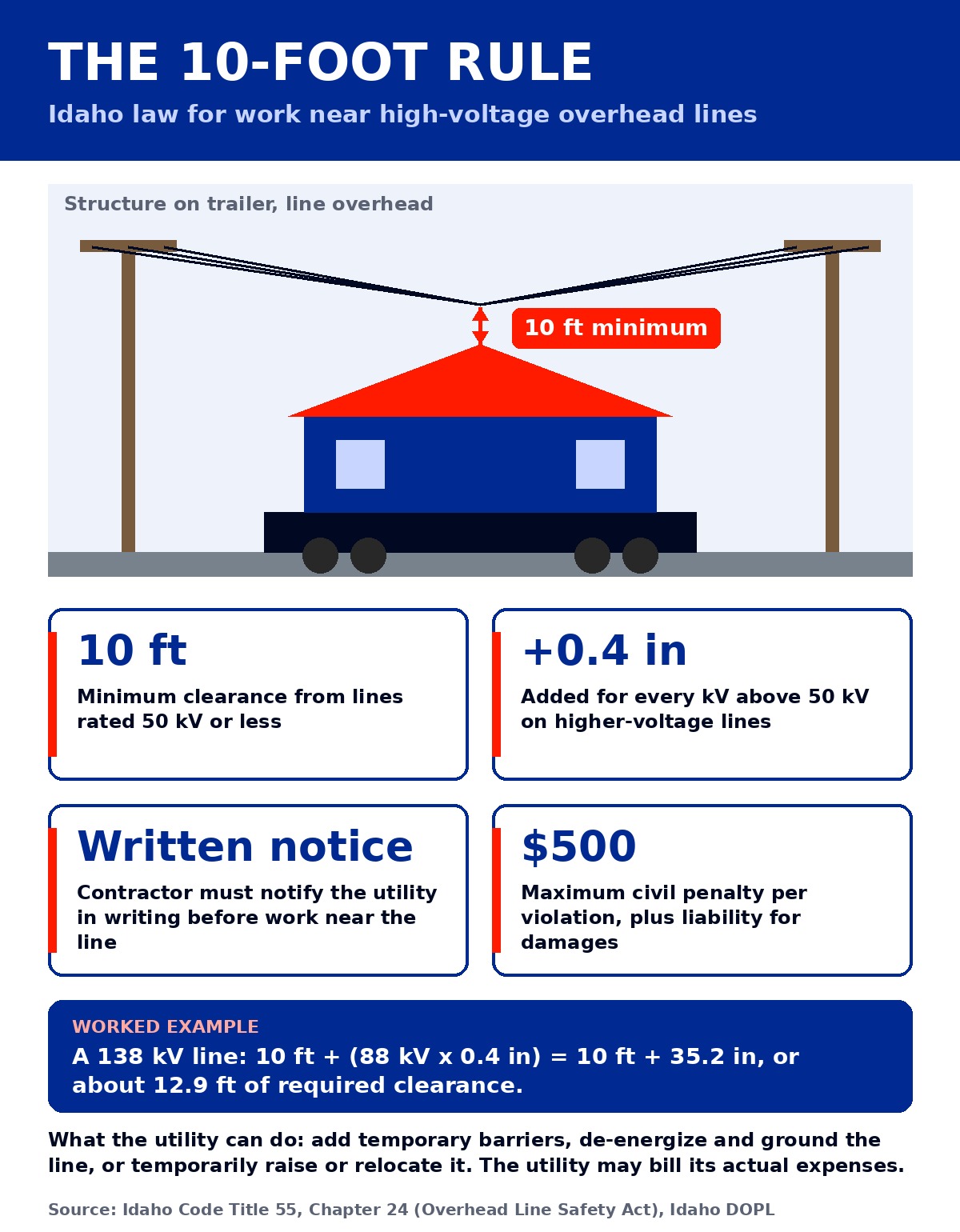
Source: Idaho Overhead Line Safety Act, Idaho Division of Occupational and Professional Licenses
What the Utility Can Do for a Moving Crew
When a structure cannot clear a line, the contractor must notify the utility in writing and reach a mutually agreeable arrangement. Options include temporary barriers, temporary de-energizing and grounding, or temporarily raising or relocating the line.
- The utility may charge its actual expenses and can require payment in advance.
- The utility does not have to begin until a written payment agreement is in place.
- The utility may deny a request that could affect the reliability of its electrical system.
- Delays on the utility’s side never authorize a crew to work inside the clearance distance.
Treat line-lift costs as part of the project budget, and lock in the date early. A utility crew that has to reschedule can push the permit window, and the moving crew’s calendar may no longer line up.
Oversize Permits and the Route Survey
Idaho’s legal vehicle height is 14 feet and legal width is 102 inches, and most structures on a carrier exceed those limits. They travel under an Idaho Transportation Department oversize permit, and the route has to be surveyed for every overhead line, signal arm, and low cable along the way.
A line that clears a structure by a narrow margin in one condition may not clear it in another, which is why a physical survey beats a map review. The same survey tells you which utilities need to be contacted before the date is locked. For structures that must be raised before transport, the hydraulic lifting and cribbing work also requires every connection to the ground to be severed first.
“Ben and the team did an outstanding job moving a detached garage for me. From the initial phone call to completion of the job. Communication was A1 and customer service was even better. Props to these guys! I Highly recommend them” Jessie Aguero, Google review
Calling 811 Before Digging at the Old Site and the New Site
Idaho law requires anyone who digs, homeowners included, to notify the one-call center 2 to 10 business days before excavation. A house move usually involves digging at both ends: cutting utility trenches at the origin and preparing foundations and service lines at the destination.
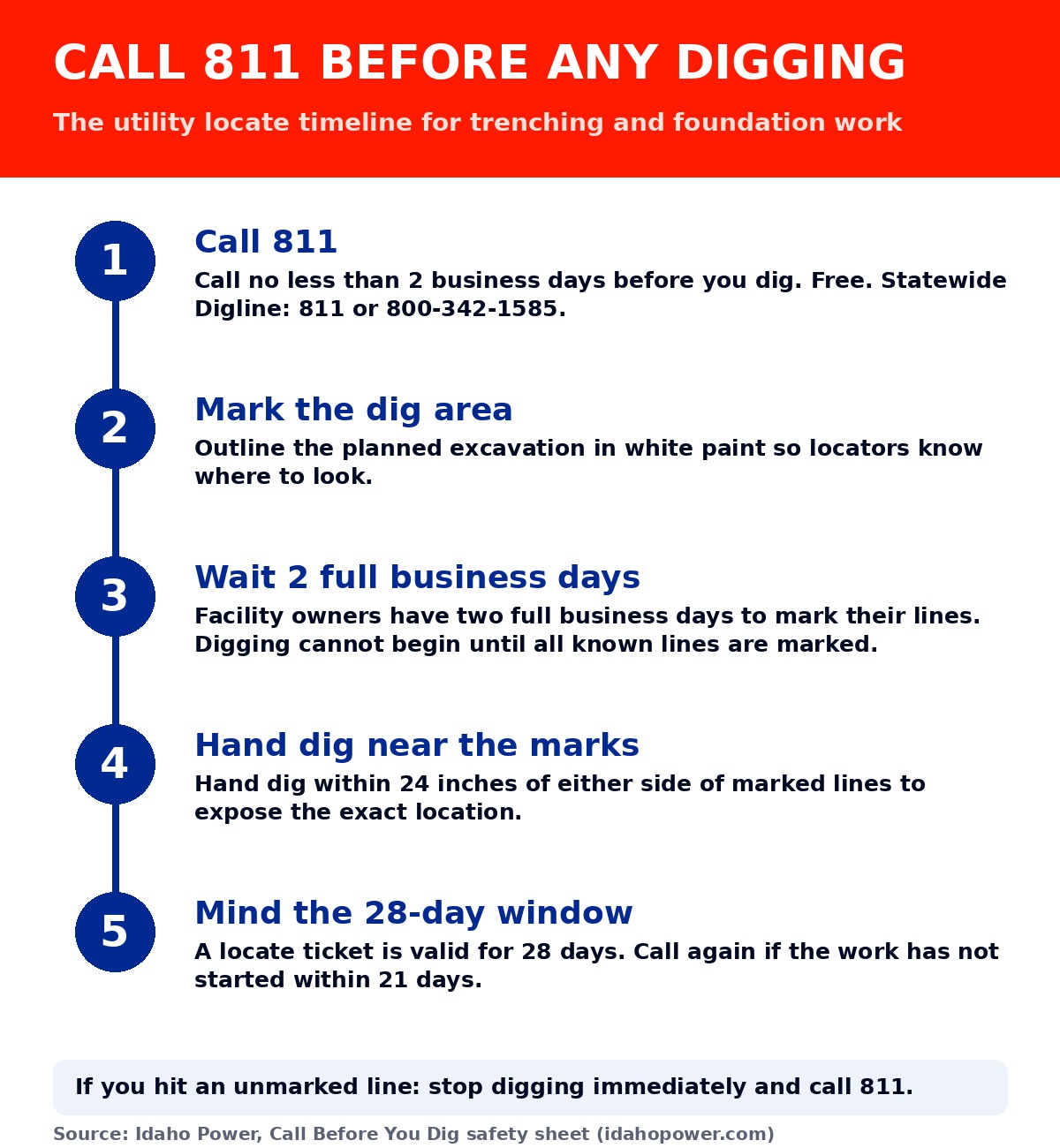
Source: Idaho Power, Call Before You Dig safety sheet
Facility owners have two full business days to mark their lines, and digging cannot start until every known facility is marked. The call is free, and a locate ticket stays valid for 28 days. If the foundation crew is behind schedule, call again for an updated locate rather than digging on an expired ticket.
Reconnecting Utilities at the New Location
Reconnection is its own project with its own lead time. Idaho Power takes new construction and service requests through its construction portal, and Intermountain Gas accepts online installation requests for homes and buildings. Once a gas line is installed, plan to have it activated and the meter set within 6 months.
Start the new-service paperwork while the old services are being shut off, so the house does not sit on its new foundation without power or water for weeks. Septic, well, and propane arrangements at the destination should be settled before transport as well.
How Much Lead Time Should You Allow?
Lead times for shutoff, line capping, and overhead line work differ by provider and by season, so no single number fits every move. Use this planning guide, then confirm each provider’s timeline in writing.
| When | What to do |
|---|---|
| As soon as the move date is confirmed | Contact every provider, ask for lead times, and book licensed trades |
| Several weeks before the lift | Finalize shutoff dates, line capping, and any overhead line arrangements with the utility |
| 2 to 10 business days before digging | Call 811 for the origin and destination sites |
| Days before the lift | Septic pumped, propane removed, final inspections complete |
| Before lift day | Walk-through with the mover to confirm every service is off and capped |
Gas and electric providers do not always process urgent requests quickly. Intermountain Gas, for example, asks customers not to use its online forms when service is needed within the next two business days, so a last-week request can easily miss the window.
Utility Disconnection for Mobile Homes, Detached Buildings, and Rural Sites
The same principles apply to every structure, but the details change with the building type. Each of the cases below has its own overlooked lines.
Mobile and Manufactured Homes
These homes connect at a pedestal or pole, with water, sewer, and sometimes gas lines running through the crawlspace. Every connection must be separated and the lines coiled or capped before the home is released for transport, and the tie-down and skirting work follows. Our manufactured and mobile home relocation crews walk owners through the connection points before the move.
Detached Garages, Shops, and Sheds
Outbuildings often have only an electrical feed, sometimes with a subpanel and a water line for a utility sink. The feed still has to be de-energized and capped by a licensed electrician, and buried conduit has to be located through 811 before anyone digs.
Rural Properties
Rural moves add wells, septic systems, propane tanks, and private lines the utility did not install. Pump the septic tank, disconnect the drain line, decommission or protect the well, and arrange propane pickup. Private lines are not marked by the utility, so a private locator may be needed to find them.
What Associated Pacific Movers Handles on Move Day
We do not perform the physical utility disconnections, because those belong to the account holder, the provider, and licensed trades. We do build the schedule around them.
- Pre-move checklist: a written list of the services your structure has, so nothing is missed.
- Route survey and permits: overhead lines, signals, and clearances identified before the date is set.
- Line clearance coordination: notice and scheduling with the utility for any line that must be lifted or de-energized.
- Lift sequencing: the jacking, cribbing, and transport work starts only after every connection is confirmed severed.
Based in Boise, ID, we move structures across Idaho and Oregon, and our crews are available Monday through Saturday, 7 AM to 7 PM at 208-376-8660. For a full list of what we haul and relocate, see our complete structural moving and hauling services, or send us your address and move details and we will tell you what your property needs before the lift.
Questions about a specific utility or property type? The team at Associated Pacific Movers can review it with you before you book trades or call providers.
Frequently Asked Questions About Utility Disconnection for House Moving
Who is responsible for disconnecting utilities when moving a house?
The property owner is responsible for requesting shutoff from each provider and hiring licensed trades to cap the lines at the structure. The moving company handles the lift, route, permits, and overhead line clearance. Accounts and meters belong to the account holder and the provider, so the request has to come from the owner.
How far in advance should I schedule utility disconnection for a house move?
Start as soon as the move date is confirmed, because provider lead times vary and utility crews work from their own calendars. Ask each provider for its timeline in writing, book licensed trades early, and call 811 at least two business days before any digging.
Will the moving company disconnect my gas, electric, or water?
No. Associated Pacific Movers does not perform physical utility disconnections. Those belong to the account holder, the provider, and licensed trades. We provide a pre-move checklist, confirm the route and permits, and coordinate overhead line clearance with the utility so the schedule lines up.
Who pays to lift or de-energize overhead power lines during a house move?
The utility may charge its actual expenses for lifting, relocating, or de-energizing lines, and it can require payment in advance. Idaho law calls for a written agreement before the work, so plan the cost into the project budget and confirm the amount before the move date is set.
Do I need to call 811 before moving a house?
Yes, if anyone will dig. Idaho law requires notice to the one-call center 2 to 10 business days before excavation, and utility owners have two full business days to mark their lines. That applies to trenching and foundation work at both the old and new sites.
Can utilities stay on until the day of the move?
They can stay on while you pack and prepare, but gas, electric, water, and sewer must be shut off and capped before crews jack the structure. Set the shutoff dates with your mover so everything is dead and capped before lift day.
What happens to my septic tank and well when the house moves?
The septic tank should be pumped and the house drain line disconnected before transport, and wells need to be capped or protected. Ask a licensed septic contractor what the old tank and drain field need after the structure leaves, and plan new septic and well service at the destination.
How do I get utilities connected at the new location?
Contact each provider early and submit new-service requests while the old services are being shut off. Idaho Power handles new service through its construction portal, and Intermountain Gas takes online installation requests. Once a gas line is installed, have it activated and the meter set within 6 months.