
Home and Building Moving for Houses, Cabins, and Commercial Structures
Home and building moving covers houses, cabins, commercial buildings, outbuildings, and other structures that need to be lifted, transported, and set down with real planning behind the move. Our crews operate out of Boise, ID, and help property owners, contractors, and business operators relocate structures safely instead of defaulting to demolition or a full rebuild.
Every project is built around access, lifting strategy, route conditions, foundation readiness, and final placement.
- Lift and support planning
- Route and permit coordination
- Controlled transport and placement
What Our Home and Building Moving Service Covers
Moving a structure is a specialty project, not a standard moving job. A successful relocation depends on how well the structure is assessed, lifted, braced, transported, and placed at the destination. That means the process starts long before the move date. Associated Pacific Movers, Inc. evaluates site access, support points, route limitations, and set-down conditions so the project has a realistic plan from the beginning.
For many property owners, structure moving is the smarter path when the goal is to preserve a valuable building, avoid a tear-down, or keep a development schedule on track. We work with homes, cabins, outbuildings, small commercial buildings, and other structures that need controlled handling. If your project is more about on-site elevation than full relocation, our house lifting and building raising service is the better fit.
Why Owners Choose to Move a House or Building
- Land development or site redevelopment
- Foundation failure or major structural repair work
- Property expansion and utility reconfiguration
- Historic or sentimental preservation
- Relocation to a better lot or more practical site
- Drainage, grading, or access improvements
The right service depends on the end goal: elevate the structure in place, or relocate it entirely to a new site.
What We Need for a Faster Quote
- Structure type and approximate size
- Photos of the building and access points
- Current location and destination details
- Ground conditions and approach constraints
- Desired timing and foundation readiness
- Any known permit or utility concerns
The more we know up front, the more accurate the lift plan, route, and quote will be.
Residential Structure Moving
Residential structure moving takes more than equipment. It takes a careful sequence that protects the building while also respecting the realities of the pickup site, route, and destination. We plan around lifting points, support systems, road access, and placement requirements so the move is controlled from start to finish.
Homeowners usually contact us when they want to preserve a house they already value, avoid losing a good structure to site changes, or move a building to another usable property. In those situations, a move can make more sense than starting over from scratch.
Structures We Commonly Relocate
- Single-family homes
- Cabins and cottages
- Garages and outbuildings
- Shops and accessory structures
- Modular structures
- Small mixed-use buildings
If the structure is a manufactured home on its own chassis, our mobile home movers handle that process instead.

Why Moving a Building Beats Demolishing It
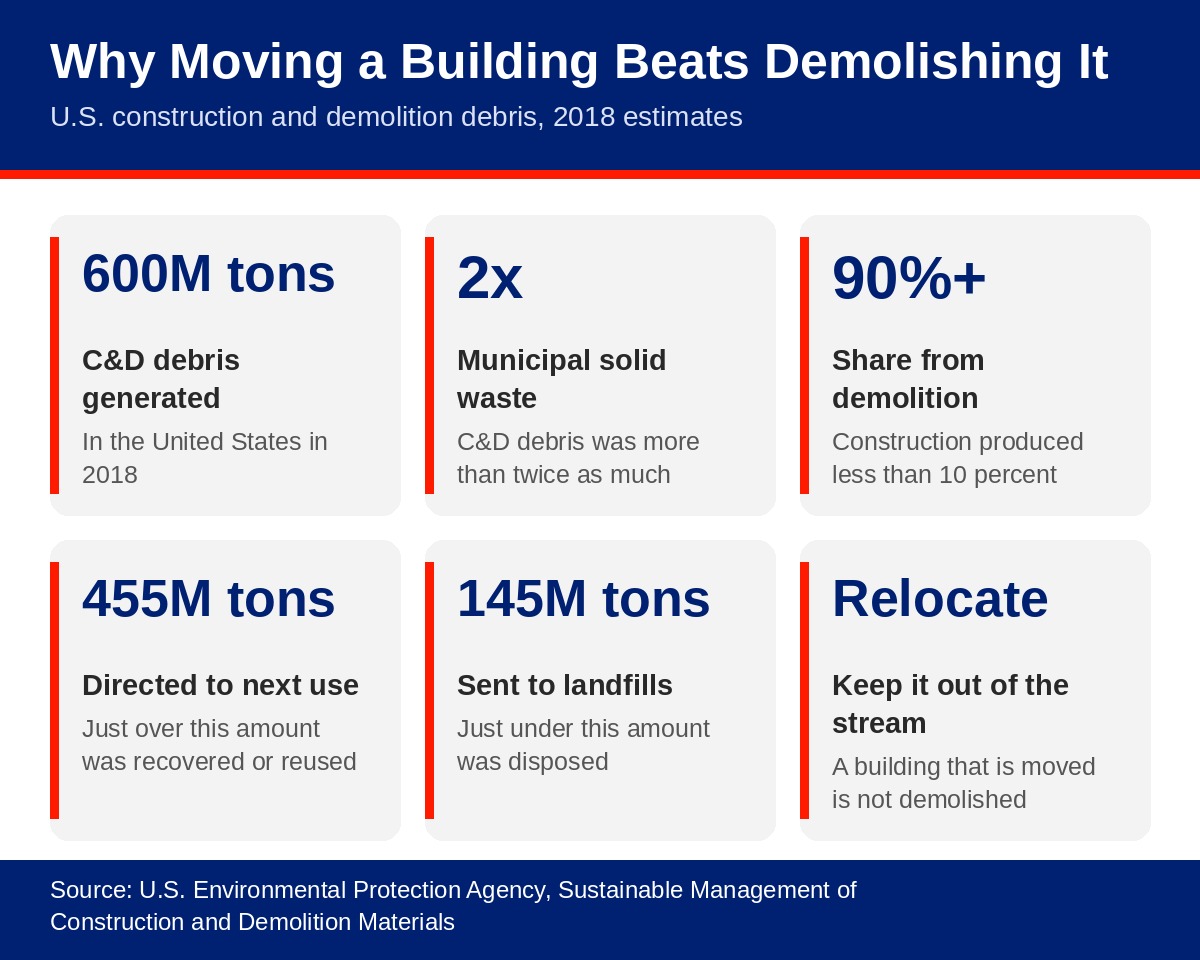
Tearing a building down creates a mountain of waste, and demolition is where most of it comes from. The U.S. Environmental Protection Agency tracks the numbers in its construction and demolition materials data.
How Home and Building Moving Reduces Demolition Waste
The EPA estimates that 600 million tons of construction and demolition debris were generated in the United States in 2018, more than twice the amount of municipal solid waste. Demolition accounted for more than 90 percent of it, and just under 145 million tons ended up in landfills.
A building that is relocated never enters that stream. The framing, siding, windows, and finishes that would have been hauled away stay in service, and the owner keeps a structure they already paid for. When a well-built home or commercial building is simply in the wrong place, moving it is often the more practical path.
Home and Building Moving vs. House Lifting
These services are related, but they are not the same.
| Service | Best For | Typical Outcome |
|---|---|---|
| Home and building moving | Relocating a structure to another lot or site | Transport and placement on a new foundation or supports |
| Building raising and house lifting | Keeping the structure on-site for foundation or elevation work | Access for repair, leveling, support upgrades, or new foundation work |
Every Move Is Built Around
- Lift points and structural support needs
- Site access, grades, and turning space
- Route constraints like overhead clearance and road conditions
- Destination readiness and foundation timing
- Communication with contractors and project stakeholders
Our Structure Moving Process
Structure relocation succeeds when the job is solved before move day.
Commercial Building Moving
Commercial structure relocation requires the same core principles as residential work, but downtime, access control, and project sequencing usually matter even more.
Commercial Structures We Commonly Relocate
- Office buildings
- Retail buildings
- Churches
- Restaurants
- Warehouses
- Small specialty buildings
When relocation protects a valuable structure or supports redevelopment, moving the building can be more practical than demolishing and rebuilding.
Why Commercial Clients Call Us
- Redevelopment and expansion projects
- Site changes that affect current building placement
- Preservation of useful or historic structures
- Need to minimize project delay versus rebuilding
Commercial moves usually run on a tighter timeline than residential ones, since a business often needs to reopen or resume operations on a fixed date. We build the schedule around that constraint rather than treating it as a nice-to-have.
A commercial relocation almost always involves more than one decision-maker. Landlords, lenders, insurers, and sometimes a permitting office all have a stake in the timeline, and each one can add a step the original schedule did not account for. We build in review time for those approvals rather than assuming the fastest possible path will hold. When the project also includes machinery or other large jobsite assets, our heavy equipment hauling crews can plan that part of the move alongside the building.
What Affects the Cost of a Structure Move
There is no single price for moving a building, because the same square footage can carry very different risk depending on the specifics below.
Structure Size and Construction
A single-story wood-frame house lifts and travels differently than a two-story home with a masonry foundation or a large commercial building. Weight and construction type drive the equipment needed.
Distance and Route Conditions
A short move across the same lot costs less than a cross-town relocation through narrow streets, low overpasses, or utility lines that need temporary clearance.
Destination Readiness
A prepared foundation or support system at the destination speeds up placement. A destination that still needs grading or foundation work adds coordination time on top of the transport itself.
Permits and Utility Coordination
Oversize routes, utility line drops, and municipal permits all add lead time and sometimes direct cost, particularly for moves that cross jurisdiction lines.
A written quote should walk through these factors one by one. Photos, dimensions, and the destination plan are what turn a rough range into a firm number.
Planning and Safety for Structure Moves
Preparation is what separates a controlled move from a chaotic one. Before a structure is lifted or transported, the project needs a clear understanding of access, support requirements, route feasibility, and destination readiness. That is especially true when a building move overlaps with contractor schedules, utility coordination, or foundation work.
We plan around real-world constraints like grades, gravel, narrow access, overhead lines, turning room, and timing dependencies. Structure moves also involve oversize and overweight transport rules. For example, state special permit rules limit permits for buildings wider than 16 feet at the base to previously used buildings, and a building too wide for a legal-width vehicle has to travel on house moving dollies or on a trailer that can be reduced to legal width when empty. Planning for those rules is part of every one of our structural moving services.
Weather is worth planning around too. A route that is straightforward in dry conditions can turn into a soft-ground problem after heavy rain, and winter ice changes how a loaded trailer handles on grades. We check current and forecast conditions before confirming a move date rather than treating the calendar as fixed no matter what.
What a Good Move Plan Accounts For
- Structural support and load distribution during lifting
- Safe approach and exit conditions at the pickup site
- Road and route constraints between origin and destination
- Final site conditions and support alignment
- Coordination with contractors, engineers, or site teams
- Timeline pressure that could affect scheduling decisions
Home and Building Moving FAQ
Quick answers for owners, contractors, and project managers planning a structure relocation.
Can you move a house to another city?
How much does it cost to move a house?
What information helps you quote a building move accurately?
Is moving a building ever better than rebuilding it?
Do I need a permit to move a building?
Do you also handle lifting and support work?
What if my project also includes moving machinery or other heavy assets?
Need a Structure Moved the Right Way?
When a house, cabin, office, church, or other building needs to be relocated, the plan has to cover lifting, route logic, transport, and final placement, not just the move itself.