
House Lifting and Building Raising for Foundation Repair and Leveling
House lifting and building raising is for homes, cabins, commercial buildings, and other structures that need elevation for foundation work, leveling, structural upgrades, or site improvements. Our crews operate out of Boise, ID, and use controlled lifting methods, support planning, and experienced hands to raise structures safely and set them back onto improved foundations or supports.
These are projects where the structure stays on-site and is elevated for repair, support, clearance, or foundation access.
- Controlled lifts with engineered support
- Foundation repair and replacement access
- Leveling and settling correction

What Our House Lifting and Building Raising Service Covers
Most people do not think about lifting a building until they are forced to solve a foundation problem, structural settling issue, or major support upgrade. Lifting creates controlled access beneath the structure so critical work can happen without tearing the whole building down.
Associated Pacific Movers, Inc. uses house lifting when the goal is to replace or repair a foundation, correct settling, improve support systems, expand crawlspace access, or create the clearance needed for a planned structural improvement. In commercial settings, raising a building can also support site upgrades, drainage improvements, and larger renovation work while preserving the existing structure.
House Lifting and Building Raising for Real Structural Problems
The point of lifting is not the lift by itself. The point is controlled access, stable support, and a safer path to repair or upgrade work underneath the structure. A proper lift plan has to account for structural load, lift points, support sequencing, and the condition of the site before work starts.
- Foundation replacement or major repair work
- Floor leveling and correction of structural settling
- Support beam or pier upgrades
- Crawlspace or basement access improvements
- Clearance needed for remodeling or utility work
- Drainage and moisture-related corrective work
What Helps Us Quote a Lifting Project Faster
- Photos of the structure and visible support conditions
- Approximate dimensions and structure type
- Known foundation, settling, or support issues
- Access limitations around the site
- Whether contractors are already involved
- Your target timing for the work
With those details in hand, the lift plan and the quote can be built around your actual structure.
House Leveling and Settling Correction
Sloping floors, doors that no longer close, and cracks that keep returning are the usual signs that a structure has settled. House leveling starts by finding out why it settled, because leveling the floors without fixing the support underneath only delays the problem.
Not every foundation issue needs a full lift. Minor settling or a single soft spot might be solvable with targeted repair work instead. A lift makes sense once the problem is widespread enough, or the planned upgrade is significant enough, that working from underneath the whole structure is the more practical path. When it does, lifting lets the crew level the structure, rebuild or replace the support below it, and lower the building onto a stable base.
Before any structure is lifted, it should be checked for structural soundness. FEMA’s guidance notes that a design professional should inspect a house first, because lifting an unsound structure can lead to expensive damage. That inspection is part of how we decide whether a lift is the right answer.
How a House Lift Works
The method behind most house lifts is well documented. FEMA describes it in the elevation chapter of its homeowner’s guide to retrofitting, and the key points are below.
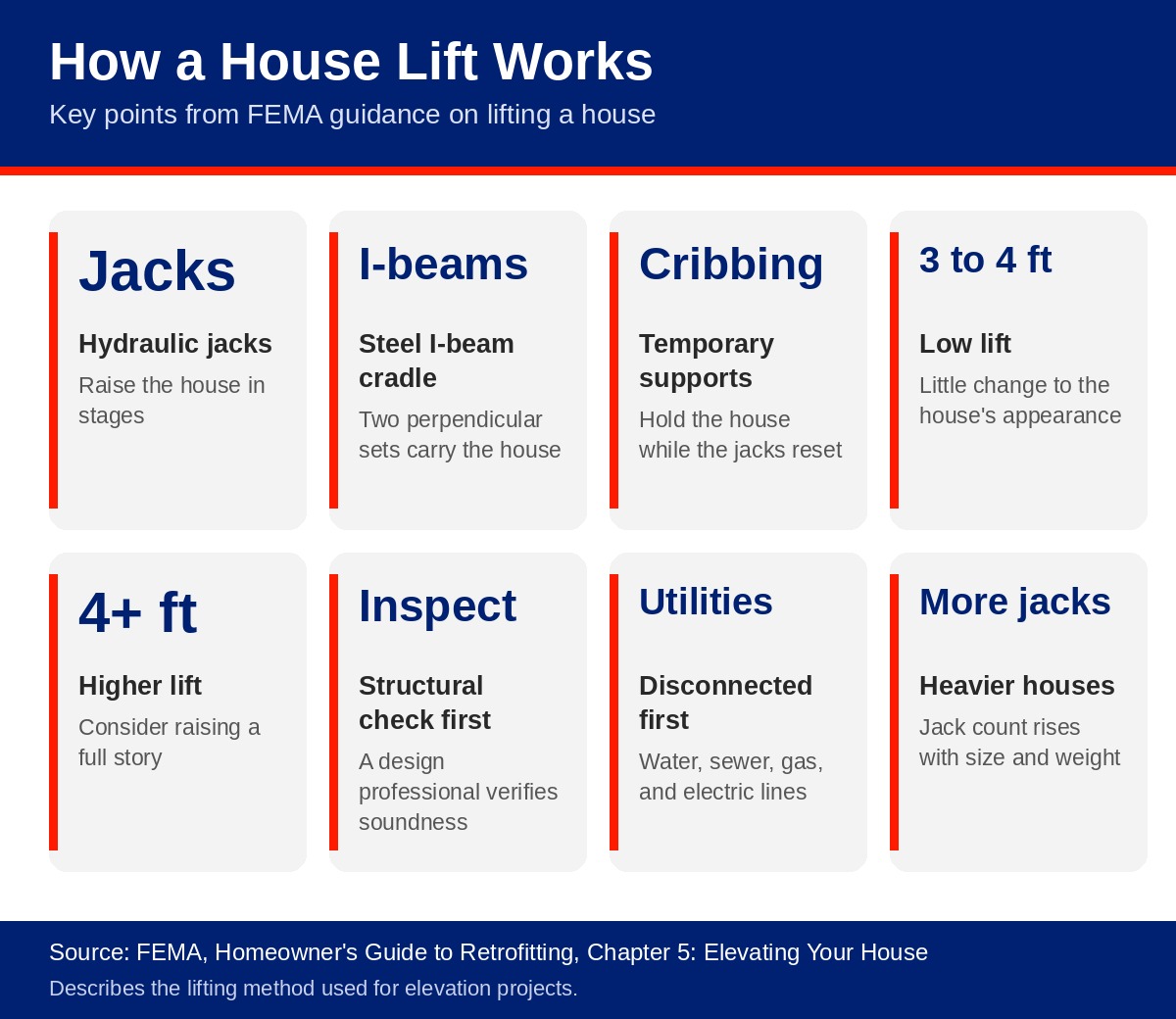
Steel I-beams are slid through openings in the foundation wall and placed perpendicular to the floor joists, with a second set placed below and perpendicular to the first. Together the two sets span the house and form a cradle. Hydraulic jacks raise the cradle in stages, and the house is held on temporary cribbing whenever the jacks need to be reset. Once the house is high enough, the foundation walls are repaired or extended below it, and the house is lowered into place.
Size and weight matter. The larger and more complex a house is, the harder it is to lift, and multistory houses are harder to stabilize while they are in the air. Exterior finishes like stucco and brick veneer have to be braced or removed, and porches, wings, and additions often have to be lifted separately. Every utility line, including water, sewer, gas, and electric, is disconnected before the lift and reconnected when the work is done.
Residential House Lifting
Residential house lifting usually starts when a property owner needs to solve a structural issue below the home without giving up on the structure itself. In many cases, lifting creates the access needed to replace a foundation, install improved supports, correct uneven settling, or prepare for other long-term upgrades. It is often the most practical way to preserve the house while still addressing serious underlying problems.
We plan each lift around structure type, support requirements, access conditions, and the exact work that needs to happen once the home is elevated, so the service stays tied to the actual objective instead of treating lifting like a generic standalone job.
Residential Lifting Projects Commonly Involve
- Foundation replacement
- Settling correction
- Floor leveling
- Support upgrades
- Crawlspace access work
- Structural repair clearance
House Lifting vs. Home and Building Moving
These services are closely related, but the intent is different.
| Service | Best For | Typical Outcome |
|---|---|---|
| House lifting and building raising | Foundation work, leveling, clearance, support improvements | Structure stays on-site and is lowered onto improved supports or foundation work |
| Home and building moving | Relocating a structure to another lot or property | Structure is transported and placed at a different destination |
If the structure is going to another site rather than staying where it is, our home and building moving service covers that process instead.
Every Project Is Built Around
- Structure type, materials, and load behavior
- Lift height goals and support sequence
- Foundation condition and repair scope
- Available workspace and access points
- Surface stability and site grading
How the Lifting Process Works
What Affects Lift Cost
Lift height, structure size, and foundation condition are usually the biggest cost drivers. A small single-story home needing a modest lift for crawlspace access costs far less than a two-story home with a full basement being raised several feet. The more of the existing foundation that can be reused, the more economical the project tends to be, while changes that strengthen a foundation add both cost and time. Support complexity and how long the temporary system needs to stay in place also factor in.
Send us photos and basic dimensions and you can request a lifting quote built around your structure.
Building Raising for Commercial Properties
Commercial lifts often require more coordination, more stakeholders, and tighter planning around ongoing property needs. For the right structure, raising the building can preserve a valuable asset while giving the project room to solve the real issue underneath it.
Why Commercial Owners Raise Buildings
- Foundation repair and support replacement
- Drainage and site correction work
- Clearance for structural upgrades
- Long-term preservation of an existing building
- Renovation planning without full demolition
What We Evaluate Before a Commercial Lift
- Structure type and material behavior
- Load distribution and likely lift points
- Access limitations and working room
- Foundation condition and support strategy
- Site grade and surface stability
Timing for a commercial lift usually depends on how many other parties are involved. A single-owner retail building can move faster than a leased office space where a landlord, a tenant, and sometimes a lender all need to sign off before work starts. We build that coordination time into the schedule from the beginning rather than discovering it partway through. If the site work also involves large machinery, our heavy equipment hauling crews handle that logistics separately.
Planning and Safety for House Lifting Projects
Good lifting work starts with understanding what the structure is doing now, what it needs to do during the lift, and what the final support condition needs to be when the job is complete. That requires lift logic, support sequencing, stable temporary conditions, and a realistic plan for the work happening under the structure.
Site conditions matter too. Access, grade, moisture, working room, and contractor timing can all affect how the lift should be approached. When a project also involves staging or oversize transport coordination, that planning happens alongside the lift, just as it does across all of our structural moving services.
Weather plays a role as well. Saturated ground after heavy rain or snowmelt is not a stable surface to work a lift from, and we will delay a scheduled date rather than proceed on soft or shifting ground. It costs less to wait a few days than to deal with a support failure caused by ground that was not ready to bear the load.
What a Strong Lift Plan Accounts For
- Structure weight behavior and support needs
- Safe beam placement and lift point spacing
- Temporary support stability during repair work
- Foundation repair sequence and timing
- Final lowering and alignment conditions
If the project is focused on a manufactured residence rather than a conventional house, our mobile home movers handle that process instead.
House Lifting and Building Raising FAQ
Quick answers for homeowners, commercial property owners, and project teams planning a lift.
How do I know if my house needs to be lifted?
Can you lift a house for foundation replacement?
How much does it cost to lift a house?
How high can a house be lifted?
How long does a building raising project take?
Do utilities need to be disconnected before a lift?
Do you also move buildings to other locations?
Can this service support commercial properties too?
Need a Structure Raised the Right Way?
When the goal is foundation access, leveling, support work, or structural clearance, the plan has to cover lift points, temporary support, repair coordination, and final lowering.